 Tasks 'n Timers

Most study plans and personal projects don't fail on a hard day. They fail on a quiet one, when nobody would notice if you skipped. There is no teacher, no manager and no deadline, only you and a plan you made in a good mood.
An accountability partner fixes that. You don't need a tutor or a full study group. You need one or two people, a study buddy, a friend, a team, who will notice when your day doesn't show up. This guide covers how to find one, what research says about making group study work, and how I use a single shared card a day to stay accountable.
What is an accountability partner, and why does one help?
An accountability partner is a person who knows what you set out to do and sees whether you did it. For studying, that is often a study buddy: someone you work alongside, in the same room, on a call, or just in the same chat. Your partner might be a classmate, a colleague learning the same skill, a friend with a different degree, or an online stranger who shows up at the same time as you.
What helps is not that they teach you. It is that they can see whether you turned up.
- Skipping becomes visible. A private goal can slide and nobody knows. A shared one leaves a gap in the chat.
- Starting feels normal. Seeing someone else do the work makes sitting down easier.
- The day becomes real. Telling someone “three hours forty” makes you look at the number.
What the research says
None of this is a trick, and it is worth being honest about how much evidence there is.
Telling someone does seem to help. In a study by Dr. Gail Matthews at Dominican University, 267 people set goals for four weeks and were split into groups. Of the 149 who finished, 43% of those who only thought about their goals accomplished them or were more than halfway there. Among those who wrote their goals, committed to actions, and sent a weekly progress report to a friend, it was 76%. The results are a conference presentation rather than a journal paper, and progress was rated by the participants themselves, so treat the exact figures with care. The direction, though, is what most people find in their own lives: a goal with a witness is easier to keep.
Small groups work best. Researchers who compared groups of different sizes working on a biology exercise (Corrégé and Michinov, 2021) concluded that groups of four seemed the best size for peer learning. More broadly, effort tends to fall as groups grow, a pattern called social loafing: in a big group, it is easier to hide.
Explaining beats rereading. Harvard's Academic Resource Center lists the benefits it sees from study groups. Two of them: you get past procrastination, and explaining a concept in your own words helps you understand it.
Knowing that you are accountable to others can help you get past procrastination.
How to make a study group work
Harvard's guidance, and the group-size research, point to a few habits:
- Keep it small. Two to four people. If it grows, split it.
- Agree the basics in the first meeting. Where you meet (in person, a call, a chat), how often, how long, and what you expect of each other.
- Give each session a job. Work through practice questions, explain a topic in turn, or review a past paper. A group with no task drifts into chatting.
- Don't let one person run it. Use a timer or take turns, so everyone talks.
- Make it safe to say “I don't get this”. A group can't help someone who is pretending to understand.
- Set a limit on confusion. If one topic eats the session, note it and move on.
- Study apart, report together. Not every session needs to be a meeting. Work alone in focused blocks and meet, or message, to compare.
Number 7 is where a shared card fits.
Study with me: showing up beside someone
“Study with me” videos and live streams are an everyday example of the same effect. One of the best known was James Scholz, whose live study-with-me Pomodoro streams ran for hours at a time and drew views in the hundreds of thousands, some past a million. The viewers weren't there to learn from him. They were there because someone was in the room, working, every day.
Two things carry over to your own life without a camera:
- Consistency over intensity. The pull is that the person is there day after day, not that they studied for twelve hours once.
- Shared presence. Seeing someone else do the work makes starting feel normal.
A shared card is the lightweight version. You don't go live. You show up once a day, with the effort you put in.
How I used it: a team, a heatmap and WhatsApp
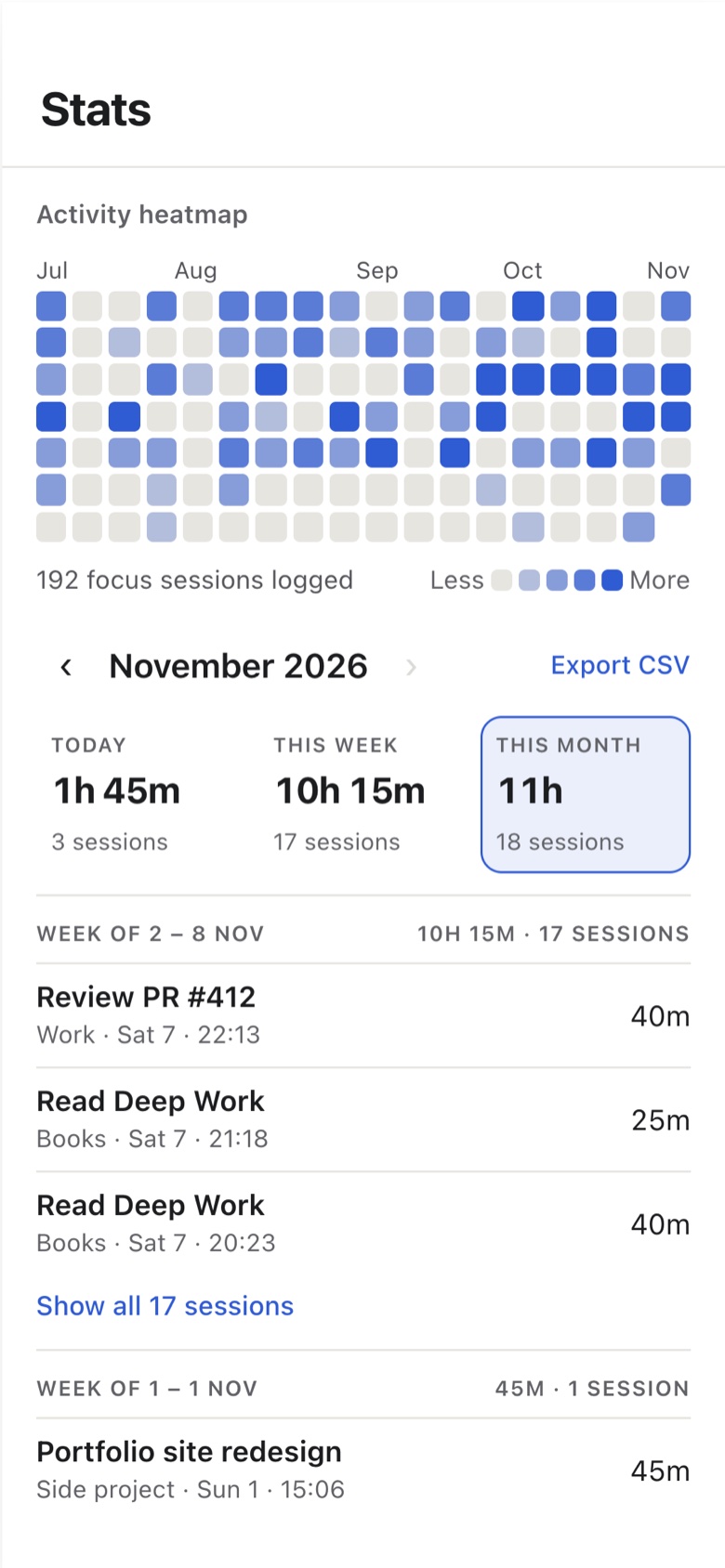
During Covid, my team and I worked apart. To stay connected, we each shared a heatmap of our Pomodoro sessions, from an app called Marinara, in a WhatsApp group every day.
It cost almost nothing, and it did three things. It showed everyone was still working towards their goals. It made a dip easy to see and easy to ask about. And it stood in for the thing we had lost: sitting in the same room and seeing each other get on with it. It kept us motivated and moving towards our goals. The share card in Tasks 'n Timers is that habit, built in.
Share your focus day with your accountability partner
On the Stats screen, tap Share above the heatmap. The app draws a card of your day and opens the iPhone share sheet. Send it to your partner in Messages or WhatsApp, drop it in a group chat or a Discord, or post it to a story or a forum.
The card shows:
- the date, the day's focus time and your number of sessions;
- a timeline of the hours you focused;
- your last 12 weeks as a heatmap;
- your streak, once you have two Win days in a row;
- the tasks you finished out of the ones you planned;
- your progress against your daily and weekly goal, if you set one.
It is drawn on your phone, and nothing is shared until you choose where it goes. There is no feed, no profile, no group and no live co-working inside the app: you share an image to the places your people already are.
How to build the habit
- Pick the audience first. One partner, a small group chat, or a public community. Small is easier to keep; public is more motivating if you can take it.
- Share effort, not performance. Hours you put in, not marks you got. A low day posted honestly beats a perfect day skipped.
- Post at the same time every day. End of the session or the evening, so it needs no decision.
- Set a goal you can reach. Set a weekly goal in Settings and let the card show your progress against it.
- Agree the rules. “A card by 9pm” is enough. A missed day is a nudge, never a punishment.
When you lose the mojo
Everyone does. A shared habit helps most in exactly that week.
- Post the small day. A 25-minute card is better than silence, and it keeps the chain unbroken.
- Look at the heatmap, not the gap. The last 12 weeks show how much you have done, not just today.
- Let others notice. A partner who sees a dip can send a message, and a partner who gets one can start again.
- Restart from one session. Run one session from one task today. That alone is a card you can send.
How to cheer on a partner whose hours dip
If someone in your group posts less, don't comment on the number.
- Ask, don't judge. “Rough week? Want to do a session together tonight?” beats “you only did 40 minutes”.
- Celebrate the return. The first card after a gap deserves more attention than the tenth in a row.
- Share yours anyway. Your card tells them the habit is still running.
Common mistakes
- Making it a contest. Comparing hours between people with different lives turns support into pressure. Compare each person with their own last week.
- Sharing too much. One card a day is enough. A running commentary is a second job.
- Padding the number. A session spent on your phone isn't focus. Honest small numbers keep the habit worth sharing.
- Using it as a stick. If a missed day brings shame, people hide. Keep the tone kind.
- Confusing a card with studying together. The card shows effort. For learning from each other, still meet and explain things to one another.
If you want a record for yourself first, a study tracker covers how to log and read your hours. For a method to fill the sessions, see the Pomodoro technique for studying.
The short version
An accountability partner works because someone can see whether you showed up. Keep the group small, give each session a job, and share one card a day with a friend or a community. Share the effort, keep the goal small enough to hit, and treat a dip as a reason to message someone rather than a reason to hide.